

The Skin Journal · HIFU & Lifting
A softly defined jawline is often one of the first changes people notice as their face ages. But treating jowls requires more than simply tightening the skin.
Jowls develop as a result of multiple changes in facial anatomy, including reduced skin elasticity, changes in facial fat distribution and weakening of underlying structural support.
At Beauty Hub Sydney, we use Liftera® 2 HIFU as one of several treatment options for addressing selected concerns associated with lower-face ageing.
The goal is not to create a different face, but to support natural-looking definition through an appropriate and personalised treatment approach.
Why do jowls develop?
Jowls are the areas of soft tissue that become more prominent along the lower jawline as facial structure and skin quality change over time.
Although collagen loss contributes to reduced firmness, it is not the only factor involved.
Changes in collagen and elastin
With ageing and cumulative sun exposure, the skin gradually loses some of its structural resilience and elasticity. This can contribute to the appearance of lower-face laxity.
Facial fat redistribution
Facial fat compartments can change in volume and position over time. These changes may contribute to heaviness around the jawline while other areas appear depleted.
Changes in structural support
Facial ligaments, connective tissue and bone structure also change with age, influencing the overall contours of the lower face.
Understanding these different contributors is important because not every type of jowl formation responds to the same treatment.
Can HIFU help tighten jowls?
High-intensity focused ultrasound delivers energy to selected tissue depths beneath the surface of the skin.
This creates localised thermal stimulation that can initiate tissue repair and collagen remodelling. In suitable individuals, this response may improve the appearance of mild to moderate skin laxity.
Liftera® 2 incorporates both line and pen applicators, allowing treatment delivery to be adapted to individual facial contours and anatomical considerations.
At Beauty Hub Sydney, treatment planning considers existing facial volume, skin quality, the degree of laxity and the areas that may benefit from focused ultrasound.
The response is gradual rather than equivalent to a surgical lift.
Not all jowls need the same treatment.
| Primary concern | Treatment consideration |
|---|---|
| Early skin laxity | HIFU may be appropriate following an individual assessment. |
| Crepey skin and reduced texture quality | Fractional RF or other suitable dermal treatments may be considered. |
| Facial volume loss | A volume-preserving approach and potential doctor-led assessment. |
| Under-chin fullness | Assessment to distinguish skin laxity from excess fatty tissue and other anatomical factors. |
| Significant excess skin | A medical or surgical consultation may be more appropriate. |
Treating the wrong underlying concern may produce disappointing results or unwanted changes in facial appearance.
This is why professional assessment is particularly important when planning lower-face HIFU.
Measured, not guessed.
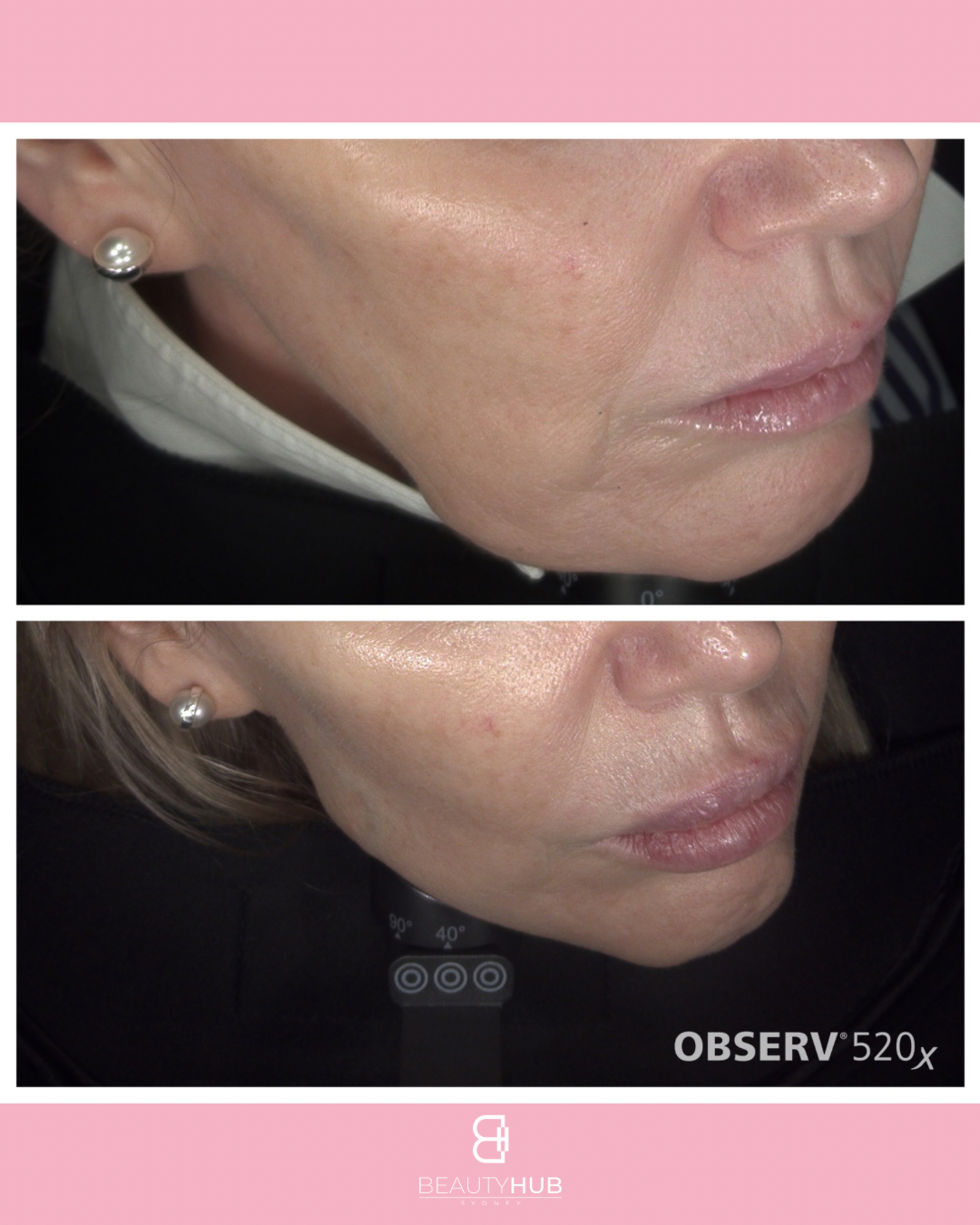
Our approach to lower-face treatment includes professional assessment and OBSERV 520x photography where appropriate.
Grey-mode imaging reduces the visual distraction of skin colour, helping us review facial contours and document visible changes over time.

Before-and-after photography provides a useful visual record but cannot independently quantify collagen production or establish the precise cause of changes in facial appearance.
Explore our article on HIFU skin tightening results for a more detailed look at treatment progression and follow-up.
When will jowls look more defined?
Some clients notice early changes after treatment, although the appearance immediately following HIFU is not necessarily representative of the final response.
Collagen remodelling takes time. We generally consider eight to twelve weeks a useful period for reviewing the developing response in suitable clients.
Changes may continue beyond this initial review period, depending on the treatment performed and individual biological response.
The appropriate number of sessions and maintenance intervals should be determined through reassessment, rather than a fixed schedule.
The Beauty Hub Sydney approach
Definition without unnecessary volume loss.
A defined jawline does not always require reducing facial volume. In fact, preserving appropriate facial volume can be important for maintaining a balanced and natural-looking appearance.
Clients with thinner faces, existing hollowness or significant volume loss require particular consideration before undergoing energy-based skin treatments.
At Beauty Hub Sydney, we consider the entire face rather than treating the jawline in isolation.
Focused ultrasound can cause unintended volume changes. No treatment protocol can guarantee that this will not occur.
Our Baseline skin consultation helps establish an appropriate starting point and discuss the potential benefits, limitations and risks of treatment.
HIFU and fractional RF: different layers, different goals.
Lower-face ageing can involve both deeper tissue laxity and changes in surface skin quality.
While HIFU may be considered for selected deeper tissue concerns, Futera Dots fractional RF may be appropriate for addressing certain texture-related concerns and improving dermal skin quality.
The two technologies are not interchangeable. Whether they should be combined depends on individual anatomy, treatment history, skin condition and appropriate recovery intervals.
A personalised treatment plan may include a combination of professional treatments and consistent home skincare, rather than relying on a single modality.
Can HIFU replace a lower facelift?
HIFU is sometimes described as a non-surgical facelift, but the two procedures are fundamentally different.
Surgical facelift procedures can reposition underlying tissues and remove excess skin. HIFU does not perform those structural surgical changes.
Instead, focused ultrasound may support gradual improvements in the appearance of skin firmness and laxity.
Clients with pronounced jowls or significant excess skin may benefit from a consultation with an appropriately qualified medical practitioner to explore other options.
Our guide to whether HIFU is worth the investment explains these considerations in more detail.
What should you consider before treatment?
HIFU is not appropriate for everyone. A thorough consultation should include assessment of your medical history, facial anatomy, treatment goals and any potential contraindications.
Possible adverse effects include temporary redness, swelling, tenderness, burns, altered sensation, nerve injury and unintended changes in facial volume.
Treatment suitability and informed consent are essential. More energy or more frequent treatment does not necessarily translate to a better outcome.
If you are concerned about treatment comfort, read our article on what HIFU feels like before your appointment.
What does the research say?
Published studies of microfocused ultrasound have investigated its use for lower-face skin laxity and jawline definition.
A systematic review published in 2023 reported improvements in facial skin laxity among selected patients, although responses varied and the available evidence had limitations.
An earlier clinical study also evaluated focused ultrasound for lower-face tightening and improvement in facial contours.
These findings support the potential role of focused ultrasound in selected cases. However, research involving other ultrasound devices cannot be interpreted as direct evidence of identical results with Liftera® 2.
Clinical references:
A Systematic Review of the Efficacy
of Microfocused Ultrasound for
Facial Skin Tightening.
Evaluation of a Microfocused
Ultrasound System for Improving
Skin Laxity and Tightening
in the Lower Face.
Good questions.
Can HIFU get rid of jowls completely?
HIFU may improve the appearance of mild to moderate lower-face skin laxity in suitable clients, but complete elimination of jowls cannot be guaranteed.
Is HIFU suitable for heavy jowls?
It depends on the underlying cause. Significant skin excess, fat distribution and volume changes require different considerations. Another treatment or surgical assessment may be more appropriate.
Can HIFU make my jawline more defined?
Selected clients may experience improvements in lower-face firmness and the appearance of jawline definition. Individual results vary.
How long does HIFU take to improve jowls?
Changes develop gradually. Eight to twelve weeks is a useful period for reviewing the response, although improvement may continue over subsequent months.
Should I combine HIFU with fractional RF?
Combination treatments may be appropriate when both skin laxity and texture are concerns. Suitability, sequencing and recovery intervals should be assessed individually.
Where can I have HIFU for jowls in Sydney?
Beauty Hub Sydney offers Liftera® 2 HIFU at 2 Market Street, Sydney CBD. A consultation is required to determine an appropriate treatment approach.
Beauty Hub Sydney · Sydney CBD
Natural definition.
Considered treatment.
Concerned about jowls or changes in your jawline? Begin with professional skin analysis and a personalised consultation to understand the most appropriate options for your face.
Discover The Baseline
Beauty Hub Sydney
2 Market Street, Sydney CBD NSW 2000
1300 217 027
This article provides general educational information. Individual treatment suitability, risks, recovery and results vary. All treatments are subject to professional assessment and informed consent.
